
Why Female Founders Get 2% of UK Venture Capital, and How to Fix It
Why British investors keep missing the best bet in venture capital

Key points
- Female-founded startups receive less funding than similar male-founded ones.All-female founding teams received 2% of UK equity investment in 2025, and teams with at least one woman founder received 15%, according to the British Business Bank's Investing in Women Code report 2026.
- All-female share of UK equity investment is getting smaller year on year.The all-female share of UK equity investment fell from 2.5% in 2023 to 2%, as AI took about three-quarters of UK venture capital in early 2026 and female-led AI startups raised an average of £800k against £5.3m for male-led ones.
- Startups with at least one female founder generate 2.5x more revenue per dollar invested.Startups founded or co-founded by women generated 78 cents of revenue per dollar invested, against 31 cents for male-founded startups, despite raising less than half as much (BCG and MassChallenge, 2018).
- The UK lacks a proven track record of investor returns generated by female founded companies.No UK dataset tracks investor returns by founder gender, so female-founded companies are clearly under-funded and probably undervalued, but the undervaluation cannot yet be proved.
- Investors frame questions to female founders differently, linked to smaller funding totals.Investors tend to ask male founders how they will win and female founders how they will avoid losing, and each extra "avoid losing" question was linked to about $3.8m less funding (Kanze et al., Academy of Management Journal).
- Investors are more likely to back founders like themselves and ~85% of investors are men.UK angel investors are 86% male, 86% white and 55 years old on average, and men hold around 85% of senior venture capital roles, so most funding decisions are made by people who back founders like themselves.
- Underfunding female founders is a self-reinforcing loop.Underfunded female founders grow more slowly, investors read that as lower ambition, and the result is smaller cheques and lower valuations in the next round.
- Current efforts fall short.Investing in Women Code signatories put 6% of their investment into all-female teams, three times the wider market's share, but the Code is voluntary, and only £115m of the £635m committed to the Invest in Women Taskforce had been invested by July 2026.
- How to fix the UK gender funding gap.The gap closes when more women make investment decisions, investors ask every founder the same questions, the UK builds a returns track record, and pension funds investing under the Mansion House Accord (around £50bn by 2030) ask the funds they back for gender data.
In 2018, researchers at Boston Consulting Group analysed five years of data from MassChallenge, one of the world's largest startup accelerators. They asked a simple question. When an investor gives a startup one dollar, how much revenue comes back?
Companies founded or co-founded by women returned 78 cents. Companies founded by men returned 31 cents36. The women achieved this with less than half the money.
In any other market, a number like this would start a stampede. Hedge funds have built empires on far thinner edges. Imagine a sector of the stock market reliably turning capital into more than twice the revenue of its neighbours while trading at half the price. Analysts would fall over each other to buy it.
British venture capital has responded with close to silence. Last year, for every £100 of equity investment in UK businesses, about £2 went to companies founded only by women1. The share was 2% the year before and 2.5% two years before. In the US the share has fallen to 1%. The price is wrong too. In the US in 2024, the median all-female team raised its Series A at a valuation of about $23m. The wider market raised at about $48m.
of UK wider-market equity investment value went to all-female founding teams
revenue per $1 of funding, startups founded or co-founded by women vs male-founded startups
Where does the author stand?
Lucy Colson advises founders on raising money for a living. I have sat in the pitch meetings, read the term sheets and watched good companies walk away with nothing. When I started pulling at this thread, I assumed I knew roughly what I would find. I was wrong about almost all of it.
What did the research find?
Seven discoveries shaped this article. Each one overturned an expectation.
- The evidence is not weak. The most important number in this debate, the one any investor would ask for first, has never been calculated in Britain. Embarrassment is not the reason. Nobody collects it.
- A shortage of money does not explain the gap. A government-backed taskforce set out to raise £250m for funds backing women and raised £635m. Two years later, only £115m of it had been invested29. The obvious explanation is a shortage of good female founders to back. The obvious explanation is not the right one.
- Bias exists, but not where most people look. The clearest evidence sits in a single type of question investors ask women in the room. The question is so ordinary almost nobody notices it. Researchers have linked it to millions of dollars in lost funding per founder.
- The gap rebuilds itself. A veteran angel investor explained why. Underfunding manufactures the very evidence used to justify underfunding. Once the loop is visible, it cannot be unseen.
- Two popular fixes do not work as their champions claim. One is a wave of new micro-investors. The other is the great wealth transfer, which supposedly puts trillions in women's hands. One of them may barely be happening at all.
- The real answer sits somewhere almost nobody looks. It sits in the pension pots of ordinary British workers, which are about to be pointed at startups on a scale this country has never seen.
- Some investors already take the trade. This article ends with those investors and with what it would take for everyone else to follow.
The article starts with the size of the mispricing and asks whether "mispricing" is even the right word.
Who is on the other side of the trade?
A mispriced asset always has someone who sees it first. When the market will not correct, every good trader asks one question. Who is on the other side of this trade, and why will they not move?
How big is the UK female founder funding gap?
All-female founding teams get roughly 1 to 2% of venture capital in the UK, the US and Europe. In the US, the 30-year average sits at about 2.4%. The share has barely moved in three decades, even as the number of female founders has grown.
How should funding gap statistics be read?
Studies measure different things, so each figure needs its definition and year. Some studies count all-female teams. Some count teams with at least one woman. Others count "women-led" businesses. Some measure the number of deals, and others measure the money. The numbers only mean something with their definition and year attached, so this article keeps both attached throughout. The full tables are in the appendix.
How is venture capital split by founding team gender?
Globally, of the venture capital invested in 2024, about 2.3% went to all-female founding teams. Mixed teams took 14.1%. All-male teams took 83.6%24.
In the United States in 2024, all-female teams got 1.0%, mixed teams 19.9% and all-male teams 79.1%, according to PitchBook data22. All-female teams had taken 2% of US venture capital in 2023. In the world's biggest venture market, the share went backwards.
In the UK in 2025, all-female teams received 2% of wider-market equity investment value. Teams with at least one woman founder received 15%. This leaves roughly 13% for mixed teams and about 85% for all-male teams1. Across Europe in 2025 the picture was even starker. About 0.5% went to all-female teams, around 12% to mixed teams, and about 87.5% to all-male teams21.
How venture capital splits by founding team
Share of venture capital or equity investment value by founding-team gender
How large is the UK funding gap in pounds?
In 2023, all-male founder teams in the UK raised more than three times what all-female teams raised in the whole of the previous decade combined; £6,5bn4.
Female-founded UK tech companies have raised £8.52bn over the past ten years. They make up 16.3% of high-growth UK tech companies but received just 8.96% of equity investment14. In market terms, they are about half as represented in the capital as they are in the companies.
The deal data tells a more optimistic story. Female founder teams won 27.5% of UK equity deals but only 16.6% of the value16. Women are getting into more deals than the 2% headline suggests. They are receiving smaller cheques. On average, male founders receive nearly six times as much early-stage capital as female founders26.
Where is the money going, and where are women scarcest?
UK startups raised about $17bn in the first half of 2026, the strongest start to a year since 2022, with AI taking around three-quarters of it15. In the AI sector, female-led startups raised an average of £800k. Male-led equivalents raised £5.3m31. Across Europe, AI startups attracted €23.5bn in 2025, and about €3bn of it went to women-founded startups21.
The larger the round, the fewer the women. Female founders' representation drops sharply in deals above €50m27.
How does the funnel narrow for female-founded companies?
A female-founded company thins out at every step from first pitch to the top of the market. In 2025, all-female teams sent 17% of the pitch decks received by the UK's reporting angel groups, down from 24% the year before. By the time the deals are counted, female founder teams are 27.5% of the count but 16.6% of the value, and all-female teams take 2% of the money. Only about 7% of UK high-growth IPOs since 2011 came from female-founded businesses20. At the very top, just 8 of 136 UK unicorn founders are women, about 6% (Hurun UK Unicorn Index 2026).
How the funnel narrows in the UK
Female share at each stage. Each bar uses its own dataset and founder definition
Scale 0 to 100%.
Is the gap wider for Black women founders?
The gap widens when gender meets race. In the UK, only 10 Black female founders received venture capital between 2009 and 2019, about 0.02% of the total4. In the US, Wells Fargo finds revenue at Black women-owned businesses grew 102.8% between 2019 and 2024, far faster than average28. These founders are building businesses by bootstrapping while the gatekeepers of capital stay out of reach. Anyone looking for an undervalued asset would find the most undervalued of all here.
Is the gap wider outside London?
Geography compounds the gap. In UK femtech in 2025, London took £77.2m across 28 deals. The North West received £327k, from a single deal19. In South Yorkshire, women hold 18% of tech roles but receive 10% of tech investment19. The outcome is not inevitable. Finland stands out internationally, with around 30% of VC reaching female founders25.
Is the UK female founder funding gap closing?
The funding gap is not closing. If the gap were simply a legacy of the past, it would close slowly as the industry modernised. Since 2023, two trends have run in opposite directions. Capital aimed specifically at women is growing fast. The mainstream market, where most of the money sits, keeps concentrating in places women are least present. The headline share stands still or slips.
What is getting worse for female founders?
The all-female share of UK equity investment was 2.5% in 2023, fell to 2% in 2024, and stayed at 2% in 202517, 1. In the US, the share halved from 2% to 1% between 2023 and 2024.
All-female share of UK equity investment, 2023 to 2025
Share of UK equity investment value going to all-female founding teams
Scale 0 to 5%.
The pipeline into UK angel groups thinned too. The share of decks those groups received from all-female teams fell from 24% in 2024 to 17% in 2025. The group of angel networks reporting their data also changed, so the comparison carries a caveat.
The price gap has widened even faster than the funding gap. In 2024, the median US Series A pre-money valuation for all-female teams was about $23.2m, against about $48m for the market. The gap has grown roughly fivefold over a decade23.
median US Series A valuation for all-female teams than for the wider market, about $23m against $48m
The AI boom sits behind all of it. AI took about three-quarters of UK venture money in the first half of 2026. Every pound flowing into a sector where women raise a sixth of what men raise pulls the national share down.
What is getting better for female founders?
The investors who have committed to change are changing. Signatories to the Investing in Women Code put 4% of their investment into all-female teams in 2023, and 6% in 2025. Their share of VC going to teams with at least one woman rose from 27% in 2024 to 32% in 20251.
The investor base is shifting. Women made up about 9% of UK angels in 2017 and 13% in 20195. By 2025, there were just over 8,000 women angels, 14.1% of the total13. The first cohort of the British Business Bank's Investor Pathways programme was 57% female general partners.
Dedicated capital is piling up. The Invest in Women Taskforce had £635m committed by 2026 against its £250m target. Women-led sectors are maturing. UK femtech funding grew from £9.4m in 2015 to more than £100m in 2025, and deal numbers rose from 18 to 5318.
What has happened in UK female founder funding over three years?
The timeline of the past three years reads like a market slowly waking up to an opportunity.
The Invest in Women Taskforce launched, co-chaired by Debbie Wosskow CBE and Hannah Bernard CBE. It went on to raise two and a half times its target.
Parliament's Women and Equalities Committee published its inquiry into female entrepreneurship. It called for mandatory reporting, a Female Enterprise Investment Scheme and childcare reform.
The government declined mandatory venture capital reporting and the Female Enterprise Investment Scheme. It said investment committee quotas were "not ruled out" if nothing improved4.
EIS and VCT allowances doubled, widening the tax-efficient route into early-stage investing for everyone.
The British Business Bank made a £1m co-investment with Angel Academe.
The Investing in Women Code's sixth annual report showed signatories outperforming the wider market again. The Taskforce passed £100m deployed.
Women Backing Women, a fund of funds backing female-led venture funds, reached a £130m first close towards £250m. Innovate UK put £4.575m behind 61 women founders.
The British Business Bank reported £90m committed to ten new funds whose general partners are majority female. Half of the first cohort of Aquis's IPO Academy was female-founded.
Each of these is a real step. None of them has yet moved the key number.
What is the cost of underfunding female founded startups?
The fairness case for closing the gap is real, but the case does not depend on it. On commercial terms alone, the gap looks like a classic market failure. Capital consistently flows away from viable opportunities. Seven things are left on the table.
How much growth is the UK missing?
In 2019, Dame Alison Rose's review for the Treasury estimated up to £250bn of new value could be added to the UK economy. The condition was women starting and scaling businesses at the same rate as men3. Parliament's Women and Equalities Committee later put the inflation-adjusted equivalent at about £310bn4. Globally, modelling suggests funding women at the same level as men could add around $5 trillion a year25. For a country with a long-running productivity problem and sluggish growth, this is an enormous pool of output, jobs and tax revenue sitting unused.
Are returns being missed?
The performance evidence, set out in full in the next chapter, points one way. Female-founded companies are at least as capital-efficient as male-founded ones, and on several measures more so. If a group of founders performs comparably while receiving a small fraction of the capital, the market is mispricing them. For an investor, this is an opportunity and not charity.
Which whole markets are being missed?
Founders build solutions to problems they understand. Underfunding women underfunds products for markets where women are the main users or buyers. Women's health is the clearest case. Menopause, fertility and maternal care were underinvested for decades despite huge demand. UK femtech funding only passed £100m for the first time in 2025. Maven Clinic, the US family-health company, raised over $425m and became a unicorn by building for a market many male investors could not personally relate to. Women also influence a large share of consumer spending. A funding system filtering out founders who understand those customers misses commercial opportunities it cannot even see.
Does diversity improve investment decisions?
Diverse teams bring a wider range of perspectives. Research links this to better problem-spotting and less groupthink. The Investing in Women Code's 2026 data hints at what this means for capital. Deals made by investment committees with a female majority went to all-female teams 11% of the time, against 8% for committees with a male majority1. Who sits in the room changes what gets seen. An ecosystem funding a narrow founder profile produces a narrow range of ideas and concentrates its risk in similar bets. Any portfolio manager would recognise this as a diversification problem.
What happens to talent and the next generation of investors?
The UK educates women to a high level, including in STEM. The country then loses much of the potential when promising founders cannot raise, scale back, or leave for other careers or other countries. Funded founders go on to become angels, mentors and fund managers. The gap therefore compounds across generations, like interest. Closing it runs the loop the other way.
How does the gap affect national competitiveness and regional growth?
The UK competes with the US, EU and Asia for capital, companies and talent. An ecosystem drawing on only part of its founder base is handicapped by design. Initiatives like the Investing in Women Code exist because the government recognises this is about Britain's position as a tech and investment centre, and not only corporate responsibility. Female-founded businesses are also more spread across the regions, and across sectors like health, education and consumer goods. Backing them spreads growth beyond London and a few hot sectors, and makes the startup economy less dependent on a single boom.
How strong is the evidence?
A good analyst states the limits of the data. Some performance studies have weaknesses. Much of the data is American. Selection effects play a part. The women who do get funded may have cleared a higher bar, which is itself a sign of bias. The strongest version of the argument does not need women to outperform men. If talent and good ideas are roughly evenly spread, a funding system this skewed is almost certainly missing good investments. Everyone pays for this.
Do female-founded startups perform as well as male-founded ones?
Female-founded startups match or beat male-founded ones on capital efficiency, burn and revenue, yet raise at roughly half the valuation. The most efficient part of the market is also the most underfunded. This article calls the contradiction the performance paradox. An analyst deciding whether female-founded startups are undervalued would start with the fundamentals.
How capital-efficient are female-founded startups?
The headline number comes from BCG and MassChallenge. Startups founded or co-founded by women generated $0.78 of revenue for every $1 of funding. Male-founded startups generated $0.31. The same study found female-founded businesses produced about 10% more cumulative revenue over five years36. The data is from 2018, covers US accelerator alumni and includes co-founded companies. The study is strong evidence and is not a law of nature.
Revenue generated per $1 of funding
BCG and MassChallenge, 2018, US accelerator alumni
The detail behind the headline is more striking. BCG looked at 350 companies, 92 of them founded or co-founded by women. The women-founded companies raised an average of $935,000, less than half the $2.12m raised by male-founded companies. Over five years they still generated more cumulative revenue, at $730,000 against $662,00054. They did more with half the money. BCG's own explanation for the funding gap is familiar from the rest of this article. Women faced more scrutiny in pitches, gave more realistic projections and asked for less. Meanwhile 92% of partners at major VC firms were men who struggled to relate to products built from women's lived experience.
Other analyses point the same way. One industry comparison puts the median monthly burn for female-founded startups at about $270k, against about $320k for male-founded ones37. Another finds women-led firms burn around 15% less capital and reach profitability sooner25.
Do female-founded companies exit faster and perform better over the long run?
The same industry analysis puts the average time to exit at about 7.9 years for female-founded companies, against 8.5 years for male-founded ones37. A study of First Round Capital's portfolio found companies with at least one female founder outperformed all-male teams by 63% over ten years38.
Two more figures circulate widely in this debate. The first says female-founded companies deliver up to 35% higher return on investment. The second says they grow revenue at 24.6% a year against 21.6% for male-led companies. I have used both myself, in WWC material and elsewhere. I have not been able to trace either to an original study, so I treat them with caution. The note on the numbers at the end of this article says more.
Why are female-founded companies so efficient?
Part of the efficiency is necessity. Founders given less learn to do more with it. Male founders are more likely to be overfunded, and overfunding can weaken discipline. Research also suggests female founders are more likely to prioritise sustainable growth and profitability over growth at any cost, and to prefer protecting the downside37.
A second reading deserves an honest hearing. If women need a stronger business to get funded at all, the ones who get through will look stronger on average. This is selection. Selection is itself evidence of the mispricing, because the market is applying a higher hurdle to one group of founders.
Why have female founders not been paid fair prices for their efficiency?
Efficiency has not translated into fair prices. All-female teams raised at about half the median Series A valuation of the wider US market in 2024, roughly $23.2m against $48m. The gap has widened roughly fivefold over a decade. One suggested reason is the AI boom, which rewards the confident "hype" framing male founders are more likely to use23.
Median US Series A pre-money valuation, 2024
All-female teams against the wider market
Lower valuations have a cost compounding over time. A founder who raises at half the price gives away more of her company for the same money. Women lose ownership as well as capital. Ownership turns a successful company into personal wealth, and personal wealth into the next generation of angel investors.
Which investors have acted on the numbers?
Some investors already trade on the numbers. Signatories to the Investing in Women Code direct three times the wider market's share of investment to all-female teams. Several told the British Business Bank they see stronger outcomes from backing female-led businesses2. In my WWC work I have often cited a UK fund, the UK Enterprise Fund. It puts over 20% of its capital into women-led businesses, four times typical UK VC. It matches or beats many UK investors. This example needs a named, checkable source before publication.
A hard truth sits here too. Sarah Turner, CEO of Angel Academe, told me there is still very little concrete UK exit data for female founders beyond standouts like PensionBee. Most of the performance evidence is American. It describes revenue and efficiency rather than realised investor returns. For a mispricing argument, this is the weak joint. Building UK exit data may be the single most useful thing the ecosystem could do.
What is the track record for female-founded companies, and what is missing?
An investment committee would ask about track record first. The question is what the evidence shows when it looks at outcomes and not only efficiency. Three main pieces of evidence exist, and each proves something different.
- BCG's revenue data, above. It is strong on efficiency. It measures revenue, not returns, and it comes from one US accelerator.
- First Round Capital's finding. Companies with at least one female founder outperformed all-male teams by 63% over ten years. The finding is real, but it comes from a single fund's portfolio.
- The exit data. This is the most under-used fact in the whole debate. In 2024, according to PitchBook, female-founded companies accounted for 24.3% of all US venture-backed exits, and 21.5% of exits in Europe. Both shares were rising. In Europe, female founders' share of exit value grew by 2.7 percentage points and their share of exit count by 3.8 points. In the US, 43 female-founded companies had reached unicorn valuations55. Female-founded companies' share of exits is roughly in line with, or above, their share of funding. My reading is simple. Once women are funded, their companies exit at least as often as the market.
None of this gives the number venture investors care about most. The missing number is realised, risk-adjusted returns, measured fund by fund. In the UK there is almost nothing at all. As Sarah Turner put it, beyond PensionBee there is little concrete UK exit data for female founders to point to.
Why is the evidence so thin?
Five reasons explain the thin evidence, and they reinforce each other.
- The sample is small. Women get 2% of the money, so very few companies exist to measure and almost no fund-returning outliers exist to point to. Venture returns are driven by a handful of huge winners. A large sample is needed before anything is statistically meaningful.
- The time lag is long. Venture-backed companies typically take eight to ten years to exit. Most companies funded since the Investing in Women Code began in 2019 have not exited yet.
- Disclosure is missing. Funds do not publish returns by founder gender. The Code tracks where money goes, and does not track what it earns. When MPs asked for mandatory reporting, the government declined.
- The definitions are messy. "All-female", "at least one woman" and "women-led" are all used, so studies do not add up into one picture.
- Underfunding caps the result. A company given half the capital has less chance of becoming the outlier who would prove the case. The missing track record is partly a product of the underfunding it is used to justify. This loop is the subject of the section on how underfunding feeds itself later in the article.
Is underfunding women really a mispricing?
An honest analyst has to separate two claims.
The first claim says female-founded companies are misallocated. They get far less capital than their share of companies, their efficiency or their exit rates would justify. This claim is well evidenced. In the US, all-female teams also raise at about half the market's median Series A valuation, roughly $23m against $48m. The money and the price both point the same way.
The second claim says female-founded companies are mispriced in the strict financial sense. Their risk-adjusted returns would be higher than the price investors pay implies. This claim is plausible, and the evidence leans towards it. It is not proven. The UK returns data does not exist. Selection effects, with women having to clear a higher bar to be funded at all, muddy the US data.
The claim this article makes is as follows. The evidence says the market is probably mispricing female-founded companies. Nobody can prove this, because the industry does not collect the data. The absence of data is not a weakness in the argument. It is part of the story.
Do female founders build category leaders?
Women who get through the gate often build category leaders. Maven Clinic raised over $425m and became a unicorn in family health. Tala, founded by Shivani Siroya, reached a reported $300m in annual recurring revenue providing credit to underserved people. Tala shows inclusive finance can be venture-scale23. These companies succeed because their founders see markets others miss. This is exactly what a mispricing looks like from the inside.
What drives the funding gap before the pitch?
In theory, markets correct mispricings. Someone spots the gap, buys the cheap asset, makes money, and others follow until the price is right. The correction has not happened after decades because the gap has no single cause, and so no single trade fixes it. The gap builds at every stage. It builds before a company is founded, in the pitch room, in the networks deals travel through, after the first cheque, and as companies scale.
A recent SSRN analysis of the UK gap51 groups the causes into three. Fewer women enter equity routes, sector mix differs, and investment processes treat founders unequally. The next three sections take each driver in turn, in the order a founder meets them. The first set shapes the market before a founder ever reaches an investor.
Why have analysts not piled into female-founded startups?
Every reader of the performance evidence will ask the same question. If the evidence is this good, why have investors not jumped on it? In a public market, an edge like $0.78 against $0.31 would be arbitraged away within months. Venture capital differs in five ways.
- It optimises for outliers, not efficiency. A venture fund needs one or two companies returning the whole fund. Revenue per pound, however impressive, does not win this argument. Investors hunt for the next hundred-times return, and an underfunded company looks less likely to be it.
- It is slow and illiquid. Feedback takes eight to ten years, and nobody can bet against a company the way they can short a share. A mispricing can persist for decades without anyone being proved wrong in public.
- It carries career risk. Nobody gets fired for backing a founder who fits the usual pattern. Backing someone who does not, and losing, becomes a story told against the investor at the next partners' meeting.
- It treats the evidence as advocacy. Data presented in the language of fairness gets filed as a diversity issue and not an investment thesis. This is one reason this article insists on the language of returns.
- It lacks the data to prove the case either way. The reasons appear in the section on the track record above. A market without a track record to point to defaults to habit. The drivers below explain where the habit comes from.
Do women start businesses from different starting lines?
Women tend to start businesses with less money. The US Kauffman Firm Survey found this "initial wedge" from the very first year52. Research on motivation suggests men are more often driven by profit and aggressive growth. More women start smaller firms giving them flexibility to balance work and family. Women have less personal wealth to bootstrap with, and are less likely to have family or friends who can write early cheques. Their businesses are also more likely to be home-based and in sectors like retail or care.
Caring responsibilities shape the start too. In the Rise Report's survey of 2,225 female founders, 24% said they started their business partly for childcare flexibility. UK childcare costs are around three times Canada's31. A US study of 651 venture ideas found a significant gender gap in founders' readiness to commit full-time at the earliest stage. Once founders did commit full-time, there was no significant difference in their access to finance or their commercial success43. The gap opens at the moment of founding, where the "second shift" at home collides with a venture culture demanding total devotion.
Women do not lack ambition. In the Rise Report, 53% of female founders defined success in financial terms, and 45% named access to funding as their main need.
Does the pipeline narrow before investors see female founders?
Fewer female-founded businesses reach an investor's inbox at all. In 2025, all-female teams sent 114 of the 661 decks received by reporting UK angel groups, about 17%, down from 24% the year before1.
Some of the narrowing is choice. Many good businesses are not suited to equity, and this is fine. Some of it is founders ruling themselves out after hearing how hard it is. Of Rise Report respondents who had sought private finance, 72% described a negative experience. For public finance, the figure was 78%.
Does sector mix explain the gap, and what is venture fit?
Women are more represented in retail, care, consumer, education and services, sectors historically drawing less venture money. They are least represented where the money now sits. Three-quarters of UK venture capital went into AI in the first half of 2026. Female-led AI startups raised an average of £800k against £5.3m for male-led ones. As megadeals concentrate capital, the barriers for founders outside the usual networks get higher and not lower.
Do women ask for less capital and get given less?
Research suggests women tend to ask for less capital and make more conservative forecasts, often because they feel they cannot or should not raise more44. This can be good discipline. It also feeds a cycle. Modest, realistic projections attract smaller cheques. Smaller cheques mean slower hiring and growth. A competitor pitching a bolder, less grounded vision raises more and scales faster. Recent data suggests women are increasingly asking for more, but the cycle is slow to break.
Do women run the household money but men invest it?
In most UK households, women manage the money. Women do not invest it.
Research by The Female Lead, presented at Women, Wealth & Capital, found the vast majority of women are the financial manager of their household, yet women invest around £500bn less than men. Independent UK studies point the same way. A 2026 St James's Place survey of 6,000 adults found 84% of women are involved in day-to-day household finances. Women lead spending decisions more often than men (45% against 33%). Men lead investing decisions (53% against 34%), and far more men invest at all, at 43% against 27% of women7. King's College London calculates men have £567bn more invested than women8. Boring Money puts the gap across ISAs, investment accounts and private pensions at £599bn, with 3.3m fewer women investors than men9. In The Female Lead's research with more than 3,500 women, 58% wanted to learn about investing, but only 8% felt very confident.
Women are trusted with the budget, then step back from the decisions building wealth. St James's Place describes women managing "the money today" while men make "the big wealth decisions for tomorrow". For the funding gap, this matters twice over. Fewer women become investors, and fewer founders grow up around conversations about capital.
Why do men talk about money and women mostly not?
One reason is cultural, and it shows up in every room I am in. Men talk about money. Over drinks, at the golf club and on the school run, men swap notes on deals, returns, pensions and tax wrappers as a normal part of conversation. This is how they learn, how they pick up the jargon and how they hear about the next investment. Women, broadly, do not. Money is still treated as private, even impolite, among many women.
The data backs up the observation. A survey for the government-backed Money and Pensions Service found 50% of men feel comfortable discussing their finances with friends, against 39% of women. The barriers people named were embarrassment, fear of judgement and a sense of failure10.
Sarah Turner raised the same point. Cultural barriers keep women out of investing long before any wealth manager or pitch meeting does. The professional route does not fill the gap. Fewer than 20% of Angel Academe's network first heard about EIS from a financial adviser.
The cultural barrier matters for the funding gap in two ways. First, fewer women become investors, so fewer women sit on the side of the table setting the price. Second, founders learn how capital works in the same informal conversations. Venture investing runs on a language of term sheets, dilution, SEIS and follow-ons. Men often absorb the language socially. Women have to learn it deliberately. This is why capital-literacy spaces like Women, Wealth & Capital fill up. They create the conversation happening nowhere else.
The pattern can shift. Women who receive ongoing financial advice are nearly four times as likely to invest (77% against 22%), according to St James's Place. King's College London found women with female financial advisers invest 11% more. Younger people are more open too. 56% of 18 to 34-year-olds are comfortable talking about money, against 37% of over-55s.
What drives the funding gap during the pitch?
A mispricing becomes visible in real time during a pitch. This is where the research is strongest, and where the gap stops being a statistic and becomes a conversation.
What questions do investors ask female founders?
Dana Kanze, now at London Business School, and her colleagues analysed nearly 2,000 questions asked of founders at TechCrunch Disrupt in New York. A clear pattern emerged. Investors asked male founders mostly "promotion" questions about gains. Examples are how will you acquire customers, what are your revenue milestones and how will you capture this market. Investors asked female founders mostly "prevention" questions about avoiding losses. Examples are how will you retain customers, when will you break even and how will you defend against competitors. Male and female investors behaved the same way32.
The pattern mattered. Each additional prevention question was associated with the startup raising about $3.8m less32. Founders tend to answer in the frame they are asked in. A prevention question produces a prevention answer, which confirms the investor's impression of a founder focused on not losing rather than winning. In the language of this article, investors price the same asset differently depending on who presents it.
The same work contains a useful finding. In experiments, founders who answered a prevention question briefly and then pivoted to growth narrowed the gap. Asked about customer retention, a founder might answer in a sentence and then move straight to the plan for acquiring new customers. This is a tactic and not a cure. The problem sits in the question.
Whose pitch story sounds convincing?
Harvard Business School research found 68% of participants preferred a pitch narrated by a male voice over an identical pitch narrated by a female voice42. The founders of the online marketplace Witchsy found a workaround saying everything. They invented a male co-founder, "Keith Mann", to deal with developers and partners. Emails from Keith got faster replies, more meetings and more respect than emails from the women who actually ran the company48.
Research from Warwick Business School adds a twist. "Hyping", meaning big, unproven claims, works for male founders. For female founders, "de-risking" is more effective at winning follow-up meetings. De-risking means showing proof, validation and feasibility41. Women are held to a different standard of evidence. The common line in the industry says men are judged on potential and women on track record. In market terms, women are asked for audited accounts while men are valued on projections.
How do networks and warm introductions affect female founders?
Venture capital runs on warm introductions. A study of the Harvard Business School New Venture Competition found exposure to VC judges made men 25% more likely to go on to found a VC-backed company. It made almost no difference for women. The quality of their ideas was not the reason. Men were twice as likely to follow up and contact the investors afterwards35. Women often report worrying about looking pushy or transactional when using a brief connection. The same behaviour in a man reads as ambition. Around 90% of VCs are men, so the warm introductions opening doors mostly run through male networks.
Kora Gault, founder of The SOLARA Boardrooms, spent years in investment boardrooms where she was often the only woman and frequently the youngest by at least twenty years. She noticed her chief investment officer's weekends away with old university friends would surface in the Monday meeting as new investment opportunities already in motion. Private dinners. Clubhouse cloakrooms. Informal introductions built on decades of shared history. "These deals weren't being formed in the office," she wrote. "They were being formed in places women weren't." She describes a twofold gap. One part is a monetary gap. The other is a strategic gap in the networks, guidance and introductions coming with investment.
In a mispriced market, information is everything. The investors who hear about an opportunity first get to price it. If information travels through rooms women are not in, women's companies are priced last, if at all.
What is homophily and the competence discount?
People back people like themselves. Research suggests female VCs are roughly twice as likely to back female-led startups45. Eye-tracking studies in equity crowdfunding show female investors look faster and for longer at female-led teams. The effect depends on the investor's financial experience46.
Women backing women alone creates its own trap. Kristin Snellman of INSEAD and Isabelle Solal studied second rounds. Female-founded firms backed only by female investors were about half as likely to raise one as those with a male investor in the first round33. Later investors, mostly men, appeared to read the first investment as a token gesture of women helping women, and not as a judgement of quality. They discounted the founder's merit and assumed favouritism. The researchers call this a "stigma of incompetence".
For a market analyst, this is the most troubling finding of all. Early investors who correctly spot the mispricing can have their signal ignored by the market following them. The fix is not fewer female investors. The fix is mixed syndicates. Women's capital is then joined and not ringfenced.
What drives the funding gap in follow on rounds?
Getting funded once does not end the mispricing. The mispricing follows women through every later stage. It appears when a company fails, when it succeeds, when it scales, and when a founder tries to find the next round.
What are the failure penalty and the success penalty?
After a startup fails, women are about 22.5% less likely than men to go on to found another VC-backed company. Women make up 13.3% of founders but only about 4% of three-time founders47. Serial entrepreneurship is one of the best predictors of success, yet investors seem more willing to give men a second chance. Men's failures tend to be read as experience. Women's failures tend to be read as a lack of competence.
Success does not fully protect women either. Yale research found women are about 28% less likely than their male co-founders to raise VC for their next startup, even after a successful VC-backed exit34. Think about this as an investor. A founder with a proven exit is about as de-risked as early-stage founders get. If the market still discounts her, the problem is not the pipeline. The problem is structural.
How does the valuation discount repeat after the first cheque?
As the performance evidence showed, the discount shows up in valuations. All-female teams raise at about half the market's Series A price, which means more dilution, less ownership and less wealth at exit. Each round priced low makes the next one harder, because the company has less capital to grow into its next valuation.
Does bias grow as female-founded companies scale?
The gap also grows inside companies as they scale. This shapes who becomes the next generation of founders and investors. A large Swedish study looked at male-led startups hyper-scaling, hiring far faster than usual. The odds of hiring a woman fell by 18% and of appointing one as a manager by 22%. Under this kind of pressure, even well-meaning leaders fall back on mental shortcuts and familiar stereotypes. Solo female-led startups showed similar patterns when growing fast. The effect shrank when founders had HR training or used structured hiring39.
Stanford research found startups built on a "commitment" culture, hiring for fit and emotional attachment, were the least welcoming to women in technical roles. Firms valuing individual achievement and using formal employment policies were more diverse, and having a full-time HR person made a significant difference. Only 4% of firms in the study had a woman leading engineering or R&D40.
Scaling bias matters for funding because tomorrow's founders and investors come from today's senior teams. Fewer women in scale-up leadership means fewer women with the track record investors look for.
Why is information about female founders fragmented?
Markets need information to price assets, and this market is starved of it. Founders struggle to find the right investors, programmes and opportunities in one reliable place. Investors say they "do not have the deal flow" with female founders. Both are describing the same problem. The ecosystem is spread across hundreds of websites, newsletters, databases and events. Information goes stale quickly, and "female-founded" is often used loosely. Deals and founders simply miss each other. When I asked investors why they back so few female founders, the most common reply was the missing deal flow. The reply describes their networks and not the market.
Is there a readiness and capital-literacy gap alongside the bias?
This point is less comfortable to say, but it matters. In my own investment-readiness assessments this year, 108 founders of all genders were assessed against the standards investors actually apply. Only about one in nine was ready for an investor introduction, and around 61% were assessed not ready. This is not a gender finding. Capital literacy is the knowledge of which kind of money fits a business and how investors decide. It is learnt largely through the networks and money conversations women are shut out of.
The readiness gap and the bias gap reinforce each other. Two things are true at the same time. The system is unfair, and a specific, closable gap exists inside many businesses.
Why does underfunding female founders become a self-perpetuating cycle?
The drivers described so far do not just add up. They feed each other. Sarah Turner of Angel Academe described this to me as a waterfall. It is the clearest explanation I have found of why the gap survives.
- It starts with money. Female founders are underfunded from the beginning. Kauffman's research found the "initial wedge" in a company's very first year. BCG found women-founded startups raised less than half as much as male-founded ones, at $935,000 against $2.12m.
- Less capital limits growth. A company with half the money hires fewer people, spends less on marketing and takes longer to scale.
- Slower growth is read as lower ambition. Investors look at the growth curve and see "slower". They do not see "underfunded". The result of the underfunding becomes evidence about the founder.
- The stereotypes strengthen. A story takes hold of women as more cautious, less confident and more likely to build "lifestyle" businesses. Investors ask female founders more prevention questions about avoiding losses, and the answers seem to confirm the impression, as Kanze's research showed.
- Founders adapt. Having learnt how they are judged, many ask for less and forecast conservatively. Some of this is good discipline. Some is a rational response to experience.
- Smaller asks bring smaller cheques and lower valuations. The founder gives away more of her company for less money, the next round starts from a weaker base, and the loop begins again. The competence discount, the failure penalty and the success penalty all deepen the loop on the way round.
Underfunding produces the very evidence used to justify underfunding
Sarah Turner's waterfall, six steps in a self-reinforcing loop
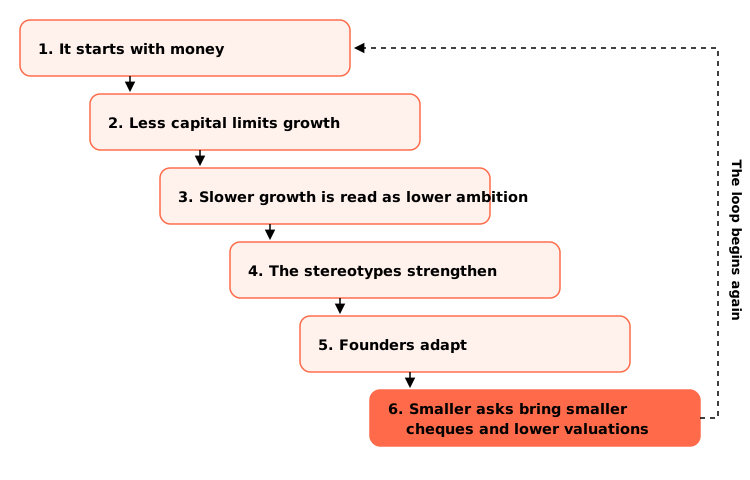
The most important point appears in the title of the diagram. Underfunding produces the very evidence used to justify underfunding. Research finding women are "more cautious" or "less confident" may partly be measuring the effect of being given less, and not a fixed trait. The loop also explains why the track record is so thin. Companies capped by their capital are less likely to become the outliers who would prove the mispricing.
In market terms, the waterfall is a self-fulfilling prophecy. The price stays wrong because the wrong price keeps generating data seeming to confirm it. For this reason, the fixes described later in the article have to break the loop at more than one point.
What is the pattern across all three sets of drivers?
The drivers form a shape when viewed together.
- Before the pitch. Women start with less capital, carry more of the caring load, work in sectors the market underweights, manage household money without investing it, and grow up outside the conversations where capital is learnt.
- In the room. Women are asked different questions, held to a different standard of proof, and left outside the networks where deals are formed.
- After the first cheque. Women face a competence discount, harsher penalties for failure and even for success, lower valuations, and scale-ups promoting fewer women.
Each driver is modest on its own. Stacked, they produce 2%. A full summary table sits in the appendix.
Who sets the price in UK early-stage investing?
In any market, the people doing the buying set the price. In UK early-stage investment, the buyers are overwhelmingly men. At the angel stage, where most first cheques come from, the buyers are mostly older, white men in London and the South East.
Who are the UK business angels?
The British Business Bank's UK Business Angel Market study5 surveyed 508 angels. It found they were 86% male and 13% female, up from 9% female in 2017. They were 86% white. Their average age was 55. Only 14% were aged 18 to 44, and just 4% were under 35. Fifty-six per cent were based in London and the South East.
The women who did invest were newer to it and wrote smaller cheques. Female angels averaged 4.7 years of investing experience, against 8.9 for men. Their average first investment was £50k, against £117k for men. Their follow-on investments averaged £29k, against £82k. Early signs of change appeared. 53% of angels said the number of women in their network had grown over three years, and 40% said they always or often co-invested with women.
The change is slow. Beauhurst and the UK Business Angels Association now count just over 8,000 women angels, 14.1% of the UK total13. Deals involving women angels have totalled £4.11bn since 2015, backing 6,595 companies, and women angels have invested £1.76bn directly. Only 2.44% of women angels hold shares in five or more companies. Most are not yet running a diversified portfolio, the thing making early-stage investing work.
Who are the UK venture capitalists?
The picture in venture capital is similar. Around 85% of senior VC roles are held by men, according to the Rise Report31. In UK venture, estimates put men at 85 to 90% of investment decision-makers. Across Europe, only 15 to 17% of decision-makers at firms managing more than €50m are women25. In the US, the World Economic Forum has reported 74% of VC firms had no women investors at all49.
Venture firms hire through their networks too. Half of female VC professionals are hired from outside the firm's existing network, against 37% of men. This suggests women rarely come through the informal routes bringing men in50.
The gatekeepers of public money were no different. According to the Rise Report, 81% of Innovate UK assessors were male. Innovate UK has since committed to 50% women assessors.
Why do the buyers matter?
The Investing in Women Code data shows the link directly. When investment committees had a female majority, 11% of deals went to all-female teams, against 8% for committees with a male majority. Measured by committee decisions and not by deals, the figures were 13% against 7%1.
The explanation is not mainly conscious prejudice. The explanation is pattern matching. Investors unconsciously favour founders who look, talk and pitch like the successful founders of the past, who were almost all men. They source deals through networks built over decades, which mostly contain people like them. The people choosing which companies to back are mostly men in their fifties, investing through those networks. It is no surprise the founders they back tend to look like the founders they know.
This is why the mispricing persists. A market only corrects when enough buyers notice the value. If almost all the buyers share the same blind spot, the correction never comes.
Who are the contrarians backing UK female founders?
Every mispricing has its contrarians, the people who see the value before the crowd and put money behind it. The UK has more of them than most countries, and they have done more than most to name the problem. The honest verdict is their bets are working where they reach. They do not yet reach far enough to move the national number.
What did the Rose Review achieve?
The Rose Review started with a number. In 2019, Dame Alison Rose, then at NatWest, led a Treasury review of female entrepreneurship3. It put the prize at £250bn, set a goal of about 600,000 more female entrepreneurs by 2030, and created the Investing in Women Code. Its weakness is it measures entrepreneurship broadly. The share of equity going to women has barely moved since.
What does the Investing in Women Code do?
The Investing in Women Code is run by the British Business Bank with the Department for Business and Trade. It asks investors to commit to backing women and to report their numbers. The signatories' record is striking. In 2025, they put 32% of their venture capital into teams with at least one woman founder, against 15% in the wider market. They put 6% into all-female teams, against 2% in the wider market. Their all-female share has risen from 4% in 2023. They also did 33% of their VC deals with teams including a woman, against 25% across the market.
The Code is voluntary and self-selecting. The firms most likely to sign are those already doing better, so the gap may reflect who signs and not what signing does. Blair McDougall, Minister for Small Business, noted signatories have outperformed the wider market for six years in a row. Kristen McLeod, Chief Strategy Officer at the British Business Bank, was more measured. The Code is "helping to gradually shift the dial, but it's clear there is much more to do."
What is the Invest in Women Taskforce?
The Invest in Women Taskforce launched in 2024, co-chaired by Debbie Wosskow CBE and Hannah Bernard CBE. It set out to raise £250m and secured £635m, from backers including Barclays, Aviva and BGF, which has pledged £300m to female-led businesses. It does not invest in startups directly. It backs specialist fund managers, including Seedcamp and Evertrue Capital, who deploy money over several years. By July 2026, about £115m had gone out, 18% of the total, across 22 investments.
The co-chairs are confident about the direction. "Surpassing £100 million in deployment shows this is no longer a conversation about intent," said Hannah Bernard. Debbie Wosskow was blunter, and put it in exactly the terms of this article. Investors should "back women or miss out on enormous return potential"29.
Which funds back female fund managers?
The Taskforce's Women Backing Women fund of funds invests in female-led venture funds. It is anchored by a £30m commitment from the British Business Bank and has reached a £130m first close towards £250m30. The fund is early, and its returns and deployment are still to come.
The British Business Bank's own Investor Pathways programme, worth £400m, has committed £90m to ten new fund managers. In its first cohort, 57% of general partners were women. The bank has also pledged £100m to the Taskforce. The programme builds the investor base, but its effect on founders will take years to show.
Which angel networks do the diligence?
Below the institutions sits a layer of women-focused angel networks. They are Angel Academe, Alma Angels, Mint Ventures, Women Angels of the North, AwakenAngels and Investing Women Angels in Edinburgh. They bring new women into investing and back female-founded companies with proper diligence. Angel Academe and SyndicateRoom have launched an EIS fund to back seven to ten women-led businesses from a £10k entry. These networks are the purest contrarian bet in the market. Their limits are scale and time. Their cheques are small relative to the gap, and much of the work relies on volunteers.
What do grants, loans and programmes contribute?
Public money plays its part. Innovate UK's Women in Innovation programme put £4.575m behind 61 founders in 2026, about £75k each. The programme is fiercely competitive. Rise Report respondents described 60-hour applications and a 96% rejection rate on public funding. Start Up Loans, run by the British Business Bank, has put £100m into London's female-owned businesses. This is debt and not growth equity.
Accelerators and readiness programmes also operate. They include Barclays Eagle Labs and AccelerateHER, Foundervine, FFinc's Forward Faster, the Fortuna Fellowship, Foundry3, Venture Forward, the Aquis IPO Academy and many more. They build skills, networks and investor access. Their outcome data is rarely published or comparable, so nobody can say which of them turn a cohort into cheques.
Capital-literacy communities work one step earlier. Women, Wealth & Capital is built on Hazel Nabarro's FemFinity Loop. Female Founders Rise and The SOLARA Boardrooms work in the same space. They teach funding routes, ownership and investing, and build peer support. They are early-stage and lightly funded, and their outcomes are not yet measured. Ecosystem data projects map where money flows and who is active. They include Beauhurst, the Lifted Project in Birmingham and Female Founder UK. The field has no single trusted source yet.
What has Parliament done?
Parliament has pushed. The Women and Equalities Committee's 2025 report4 called for mandatory reporting, a Female Enterprise Investment Scheme and childcare reform. The government's response4 in January 2026 declined mandatory VC reporting and the new scheme. It accepted reviews of childcare and parental leave, and committed Innovate UK to gender-balanced assessment panels.
Why has the funding gap remained despite greater support for female founders?
The contrarians are right, and they have money. The market has not followed. Most of the effort so far has gone into participation through programmes, events, pledges and pitch nights. The gap is in capital. Participation and capital are different things, and the data shows the distance between them.
Are the contrarians too small to move the price?
UK startups raised about $17bn in the first half of 2026 alone. The Taskforce has deployed about £115m in two years. Every female-focused fund is welcome, but they are small next to the mainstream market, and the mainstream is where the 2% figure is set. A handful of buyers cannot reprice a whole market.
Why has only £115m of the £635m Taskforce money been deployed?
The Taskforce figure needs explaining, because sceptics reach for it. If £635m is available and only £115m has been invested, the figure might prove there are not enough good female-founded companies to back. The evidence available does not support this reading. Most of the gap is explained by how the money is structured.
raised by the Invest in Women Taskforce against a £250m target, vs deployed by July 2026
- Two layers of funds. The Taskforce does not invest in startups directly. It commits money to specialist fund managers, who then invest it in companies over a normal three-to-five-year investment period29. Each layer takes time.
- Commitments, not cash in hand. The £635m is commitments. A large part of it is BGF's separate £300m pledge to female-led businesses, which BGF deploys over several years. The Women Backing Women fund of funds only reached its £130m first close this year.
- New funds. Many of the funds being backed are new, often run by women raising their first fund. They have to finish raising their own fund before they can make a single investment.
In my judgement, 18% deployed after about two years, through two layers of funds, is broadly what anyone would expect. The figure is not a red flag in itself. The public reporting raises no concerns about the quality of the founder pipeline. Deployment has been accelerating, through Seedcamp's funds, Evertrue Capital and Wild Frontiers among others.
The pipeline question is not closed. Two signals are worth watching. The share of decks reaching UK angel groups from all-female teams fell to 17% in 2025. In my own readiness assessments, only about one in nine founders, of all genders, was ready for an investor introduction. Readiness is a real constraint, but it is not specific to women. The Taskforce could settle the question by publishing how much of its £635m has been called rather than committed, and what its funds' pipelines look like. These are the right questions to put to it on the record.
Do women get into the room but not the big cheques?
Female founder teams won 27.5% of UK equity deals but only 16.6% of the value. Aquis's first IPO Academy cohort is 50% female-founded, yet only about 7% of UK high-growth IPOs since 2011 came from female-founded businesses. The pattern repeats at every stage. Access to programmes is plentiful. Access to large rounds is far scarcer.
Is the money flowing where women are scarcest?
Three-quarters of venture money goes to AI, and female-led AI rounds average a fraction of male-led ones. The national share can fall even while women-focused initiatives grow. The tide is going out faster than the new boats arrive.
Why is change voluntary and why do laggards not sign?
The Investing in Women Code is voluntary, and the firms most likely to sign are those already doing better. In January 2026, the government declined mandatory VC reporting and ruled out a Female Enterprise Investment Scheme. The Financial Conduct Authority cited the burden on smaller firms. The government left the door open to investment committee quotas if nothing improves.
Is there too much fixing of women and not enough fixing of the system?
Much of the support market trains founders to pitch better. Readiness matters. Kanze's research shows the problem sits partly in the questions investors ask, and not only in the answers founders give. Very few programmes publish comparable outcome data, so nobody can tell which ones move founders from a cohort to a cheque.
Is follow-on money the missing middle?
Women-focused angels and funds are good at first cheques. Few can lead or fill a Series A. Later rounds depend on mainstream investors who still apply old patterns, so early support can leave founders stranded. An all-female cap table can even make the next round harder.
Does the venture model reward only one shape of company?
Sarah Turner explained the maths to me. Traditional VC funds need a few companies to return 100 times their money, because only around one company in twenty returns the fund. Angel Academe instead targets at least a 10-times return per company. Many of its exits have been quieter acquisitions and acqui-hires, where teams keep their jobs and the technology survives. Capital-efficient, steady-growth businesses, the kind the performance data says women often build, can be excellent investments and still not fit a model built around rare outliers. This does not mean women cannot build outliers. It means the mainstream model filters for one shape of company. Much of the support for women has not yet built the alternative routes at scale. Those routes include angel-led rounds, debt and exit support.
Exits are hard even when the company is good. Sarah described acquirers who stall transactions on purpose, knowing a small target will run low on cash and accept a worse price. Many founders in her portfolio are, in her words, tired but determined to get strong exits. This is why she wants to build an exit accelerator for female founders, and why exit support belongs on the list of solutions. In a mispricing story, exits are where value is finally realised. If women's exits are squeezed, the market never sees the returns correcting the price.
Do new investors take years to matter?
Women angels are still newer to investing than men, and write smaller cheques. The average first investment is £50k, against £117k. New female general partners are only now raising their first funds. The investor base is changing, but its influence on allocation builds over a fund cycle and not over a year.
Is public money hard to reach?
Innovate UK's Women in Innovation awards are valuable. Rise Report respondents described 60-hour applications and a 96% rejection rate on public funding. Grants are often treated as the answer for women's businesses while equity goes elsewhere. Grants cannot close a growth-capital gap on their own.
Are wealth managers opening the door?
Even women with money to invest often do not hear about early-stage investing. Fewer than 20% of Angel Academe's network heard about EIS from a financial adviser, Sarah Turner told me. She says the major wealth managers also make it hard for small or new funds to reach their clients. The capital able to reprice the market sits in portfolios whose managers never mention it.
Which popular fixes for the female funding gap are false signals?
Every market has its false signals, ideas looking like they should move the price and not doing so. The female funding gap has several. They feel intuitive, even empowering. Looked at closely, they do not get more capital into female-founded companies at the scale needed.
Does micro-angel investing help female founders?
Micro-angel investing is appealing in theory. Lower the entry ticket to £500 or £1,000, and far more women can become investors. More women investing should mean more women funded.
In practice, micro-angel investing rarely helps the startup. Sarah Turner, whose Angel Academe has backed female-founded tech and science companies for 14 years, is blunt about it. Founders waste precious months collecting tiny tickets. Dozens of small investors complicate the cap table, and special purpose vehicles add legal risk. Angel Academe aims for £250k raises and needs at least ten investors per deal to get there. The investor does not win either. With £500 in one company, an investor cannot build a portfolio, and early-stage investing only works as a portfolio. Early-stage investors should only ever put in money they can comfortably afford to lose.
A regulatory point also applies. Angel Academe's £10k minimum ticket reflects Financial Conduct Authority rules for high-net-worth and sophisticated investors. The minimum pays for the proper diligence a meaningful ticket allows.
Her alternative is a pooled EIS fund with a £10k entry, spread across all of a network's deals. Angel Academe's fund covered eight deals last year. Investors still take part in diligence and attend events, but with the risk spread properly, and the founder gets one meaningful cheque instead of fifty small ones. Micro-investing may still have a place as a learning route for new investors. It is not a funding route for founders.
Will the great wealth transfer fund women founders?
The great wealth transfer comes up a lot, and I have used it myself. Somewhere between £5.5tn and £7tn will pass between generations in the coming decades, and women are expected to end up controlling around 60% of UK wealth. The argument says a wave of female capital is on its way.
The detail undoes the headline. As Sarah Turner and J. Penney Frohling set out in IFA Magazine, the average age of inheritance in the UK is 61, according to the Institute for Fiscal Studies. Some people born after 1980 may wait until 70. The median inheritance, according to HMRC and ONS data, is about £33,000. Around 45% of UK net wealth, £5.6tn, sits in property. Households over 65 hold £1.7tn of investment wealth. About a million affluent households out of 28 million hold 70% of liquid wealth, £1.2tn, according to Ethos Partners' Atlas from June 2025. Three-quarters of older people surveyed by Just Group would rather enjoy their retirement than leave money to their children.
The transfer is late, illiquid and concentrated. As the article's title puts it, much of it is not really intergenerational at all. It mostly lands with people in their sixties, and with households already holding wealth. It will not create a new generation of young female angels. Even where money arrives, it has to get past wealth managers, who rarely mention early-stage investing.
The finding cuts both ways. It weakens the "women will control 60% of UK wealth" hook. It strengthens the case for teaching women to invest now, with the money they earn, rather than waiting to inherit.
Is women-only capital enough on its own?
Female-led funds and angel networks are vital. If women are the only ones backing women, the market can read the investment as a favour and not as a judgement. This is what Snellman and Solal found. The answer is not fewer female investors. The answer is mixed syndicates. Women's capital is then joined and not ringfenced.
Does teaching women to pitch like men work?
Pitch training has value. The evidence says the questions differ, and not only the answers. Asking founders to adapt to a biased process, without changing the process, puts the whole burden on the people with the least power. It also produces a lot of events and not much capital.
Will waiting for the pipeline to fill close the gap?
The argument says funding will follow once enough women study STEM and start companies. The share of VC going to all-female teams has hovered around 2% for decades, while the number of female founders has grown. Deals are rising faster than value. The pipeline is filling. The capital is not following.
Does unconscious bias training change investment decisions?
Bias training is common in investment firms, and it can build awareness. On its own, the evidence it changes decisions is weak. Changing the process itself works better. Standard questions, set criteria and joint evaluation do more, as covered in the next section.
Would a separate tax break for women close the gap?
MPs recommended a Female Enterprise Investment Scheme in 2025. It would offer bigger tax breaks for investing in women-led businesses, along the lines of SEIS. The government turned it down in January 2026 over subsidy-control rules. It may not be dead. Waiting for it is not a plan.
How can the UK fix the female founder funding gap?
If the problem is a mispricing, the fix is to change who sets the price and how they set it. Fixes adding only a separate pot of money are less likely to move the national number. Fixes changing mainstream allocation are more likely to.
What is the biggest lever for closing the gap?
The change with the longest reach is putting more women in the investor's seat. It works on several causes at once. It widens the networks deals come through, changes who asks the questions in the pitch, and brings people with lived experience of underserved markets into investment decisions. The Code data backs this up, because female-majority committees back all-female teams more often.
The groups doing this well do not just invite women to invest. They teach them how, give them a portfolio approach and do the diligence with them.
- Alma Angels. Alma Angels trains women through Alma College, with no minimum capital needed to start learning. It has trained more than 600 leaders and backed more than 250 women-founded or co-founded ventures, which it says have created $1.6bn of enterprise value. Its mission is $1 trillion in women-led wealth by 2050.
- Angel Academe. Angel Academe has spent 14 years building a network about 70% female, backing IP-rich tech and science companies founded by women. Its pooled EIS fund lets new investors start with £10k spread across every deal. It is also exploring an exit accelerator for female founders with the law firm Kingsley Napley and the investment bank DC Advisory.
- Regional angel groups. Mint Ventures, led by Gillian Fleming, runs a women-led angel group and training pathway in Scotland. Women Angels of the North, AwakenAngels in Derry and Investing Women Angels in Edinburgh are taking the same model to regions where angel money is thinnest.
- UK Business Angels Association. It runs a Women Backing Women programme and tracks the numbers with Beauhurst.
- Women, Wealth & Capital. It works one step earlier, on the capital literacy coming before a first investment. It is built on Hazel Nabarro's FemFinity Loop. Women grow businesses, raise, exit and reinvest in the next generation of founders.
Two cautions apply. Women investing only alongside other women can trigger the competence discount, so the goal is women in every syndicate and not a separate one. This lever is also slow. A new angel's first cheques today become real influence over five to ten years. This is exactly why the lever needs to start at scale now.
How can investors change how the price is set?
The second lever is the decision process itself. Two approaches from the US show what this looks like.
Kapor Capital stopped using pedigree as a proxy for talent. Traditional VCs look for elite degrees, prestigious employers, warm introductions and a straight line of success. Kapor looks at the "distance travelled". This means the obstacles a founder has overcome, resilience on non-traditional paths and lived experience of the problem they are solving. It takes open online submissions rather than relying on introductions. The firm reports 100% of its recent new investments included at least one underrepresented founder, while still aiming for top-quartile returns53.
Village Capital's toolkit recommends three steps to make judgement fairer and more accurate42.
- Set the evaluation criteria, such as market, team and technology, before meeting the founder.
- Assess several ventures together, side by side, rather than one at a time, which reduces reliance on stereotypes.
- Ask every founder the same core questions, which tackles the promotion and prevention question gap head on.
What other ways exist to correct the market?
Beyond those two levers, the evidence points to a longer list of fixes, each with an owner.
- Standard reporting. Funnel data by founder gender would show where the price goes wrong. It would cover decks, meetings, term sheets, cheque sizes and follow-ons. Nobody can fix what they cannot see, and the Code shows reporting shifts behaviour among those who do it. LPs, the British Business Bank and the FCA could require it. Today it is voluntary through the Code, and mandatory reporting was rejected in January 2026.
- LPs making diversity data a condition of investment. LPs are the investors' investors, and when they ask, fund managers listen. Pension funds, endowments and the British Business Bank, as an LP, could all do this. The Bank already applies it to its own commitments.
- Accountability inside firms. Firms can report internally on deals screened and funded by gender, and tie partner pay or bonuses to inclusion. This is rare today.
- More women on investment committees. Female-majority committees back all-female teams more often. Fund partnerships and LPs can make it happen, and the government has said quotas are "not ruled out" if VC figures do not improve. Firms can also recruit decision-makers from outside their own networks.
- Mixed syndicates and co-investment. Women-led angel networks partnering with larger funds, and British Business Bank co-investment, avoid the competence discount and bring follow-on capacity. It is happening case by case, such as the Bank's £1m co-investment with Angel Academe.
- Dedicated Series A and follow-on capital. Funds like Women Backing Women and BGF, which has pledged £300m to female-led businesses, could fill the missing middle where women's rounds stall.
- Public procurement targets. Government could set a target, for example 10% of public contracts, for women-led suppliers. Revenue is the clearest signal for investors, and a target reduces reliance on pitching. MPs have recommended it, but no target has been set.
- Non-dilutive and alternative finance. Many good businesses are not venture-shaped. Debt, grants and revenue-based finance, from lenders, BGF, Start Up Loans and Innovate UK, keep ownership with founders. This is growing.
- Childcare and parental support for the self-employed. Measures like making childcare tax-deductible would remove a barrier at the moment of founding. The government accepted reviews in January 2026.
- Structured hiring in portfolio companies. VCs can encourage early HR and structured hiring, which stops the scaling bias removing women from future leadership. This is rare at seed stage.
- Exit support and recycling. Women who exit well become the next angels and general partners. Angel Academe's planned exit accelerator and Women, Wealth & Capital's work are early examples. Angel Academe plans to revisit its accelerator in 2027.
- UK exit data. Beauhurst, the British Business Bank and researchers could build the UK exit record for female founders. It would turn a US efficiency story into a UK returns story, and it is largely missing today.
- Better ecosystem navigation. Founders and investors cannot find each other in a fragmented market. Beauhurst, the Lifted Project and Female Founder UK are all working on this, but no single trusted source exists yet.
How can the UK build the track record for female-founded companies?
The missing track record keeps the market from correcting. Building the record may be the single highest-value fix of all. Every other argument in this article becomes easier once the UK has its own returns data. Six steps would get there.
- Add outcomes to the Investing in Women Code. Signatories already report where their money goes. Asking them to report follow-on rounds, exits and returns by founder team as well would build a UK returns dataset within a few years.
- Build a UK exit database. Beauhurst and the British Business Bank already hold most of the raw data. A joint study of female-founded exits since 2010 would fill the biggest gap in the evidence. It would cover who exited, at what value and with what return to investors.
- Track cohorts over time. Follow Innovate UK Women in Innovation winners, accelerator cohorts and Taskforce-backed funds for five to ten years, alongside comparison groups. This would show which support actually changes outcomes, and settle the pipeline question for good.
- Publish fund-level results. As the new female-led funds backed through Investor Pathways and Women Backing Women report their first numbers, the track record moves from individual founders to fund managers. LPs understand this evidence best.
- Get LPs to ask for it. Pension funds and other LPs could require gender-split outcome data from every fund they back, as part of standard due diligence. Mansion House money is flowing into venture by 2030, so this is the moment to ask.
- Agree one set of definitions. The British Business Bank, Beauhurst and the Code should use the same definitions of "all-female", "mixed" and "female-founded", so every study adds to one picture.
A second reason exists to build the track record. It breaks Sarah's waterfall at its weakest point. Once UK evidence shows funded female founders deliver, the story of "cautious" or "lifestyle" founders becomes much harder to tell, and the loop loses its fuel.
Are there reasons to be optimistic about UK female founder funding?
The headline number is stuck at 2%. Underneath it, the thing most likely to unstick it is moving. The thing is who controls the capital. An analyst looking for signs a mispricing is about to correct would see ten signals.
- The buyers who see the value are multiplying. Women angels rose from about 9% of UK angels in 2017 to 14.1% in 2025, and deals involving them have totalled £4.11bn since 2015. The first cohort of the British Business Bank's Investor Pathways programme was 57% female general partners.
- Institutions have put real money down. The Invest in Women Taskforce raised two and a half times its target, and Women Backing Women has £130m to put into female-led funds. Ten new funds with majority-female general partners have received £90m.
- Where investors commit, the numbers move. Investing in Women Code signatories' all-female share rose from 4% to 6% in two years. This is three times the wider market. If every investor behaved like the signatories, the national figure could triple.
- The efficiency case is well established. Female-founded startups have repeatedly shown more revenue per pound invested. As more UK exits happen, the evidence will become a returns story investors cannot ignore.
- Women-led sectors are maturing. UK femtech deals rose from 18 in 2015 to 53 in 2025. Female-founded UK tech companies have raised £8.52bn over the past decade.
- The route to public markets is opening. Half of Aquis's first IPO Academy cohort is female-founded.
- Infrastructure is spreading beyond London. Women Angels of the North, AwakenAngels, Investing Women Angels, the Lifted Project in Birmingham and Venture Forward in Manchester are building local routes to capital. South Yorkshire has set up a Women in Tech & Investment Taskforce.
- Women want to invest. In The Female Lead's research, 58% of more than 3,500 women wanted to learn about investing, while only 8% felt very confident. This gap is teachable, and Women, Wealth & Capital sessions this year have sold out. The money conversations are shifting too. Younger people are far more comfortable talking about money than older generations, and women with an adviser are nearly four times as likely to invest.
- Policy has a stick in reserve. The government has said investment committee quotas are "not ruled out" if venture figures do not improve.
None of this has reached the national figure yet. It should, because the people now being trained and funded as investors will be making allocation decisions for the next 20 years.
When will the UK female founder funding gap correct?
The answer will not come from a single fund, programme or policy. It will come from the mainstream market changing who decides, and what those decision-makers are asked to report. Realistically, this takes a fund cycle, which is about a decade.
Venture funds typically invest over four or five years and return money over ten. The women now being funded as general partners through Investor Pathways and Women Backing Women will make most of their investments between now and around 2030. Their first exits, and the next generation of female angels those exits create, come later.
What are the three phases of the correction?
My honest view is the correction comes in three phases.
- From now to 2028, the investor base shifts. Taskforce and Women Backing Women money is deployed. More female general partners and angels start writing cheques. Expect the signatory figures to keep improving while the wider-market figure stays near 2%, dragged down by AI megadeals.
- From 2028 to 2032, the wider market has to move, or be made to. This is the test for the Investing in Women Code. If voluntary action has not shifted the national share, the government has said quotas on investment committees are "not ruled out". LPs, especially pension funds, will be the decisive lever.
- From 2032, the loop starts to compound. Founders backed in this decade exit, reinvest and become investors themselves. This is the FemFinity Loop at national scale. Founders build, raise, exit and reinvest.
Which three variables decide how fast the gap closes?
Three variables will decide how fast the correction happens.
First, whether LPs start treating gender data as a standard part of due diligence. LPs are the pension funds and institutions behind the funds. If they do, change could come within five years. If they do not, we may be having this conversation in 2036.
The point is not abstract. In May 2025, seventeen of the UK's largest workplace pension providers, including Aviva, M&G and NatWest Cushon, signed the Mansion House Accord. They committed to put at least 10% of their default funds into private markets by 2030, with at least half of the total in the UK. This could unlock around £50bn, and the government has said it may legislate if the targets are missed6.
This is the money mentioned at the start of this article. It is the pensions of millions of ordinary workers, many of them women, about to be pointed at British startups on a scale this country has never seen. Most of it will flow through venture and growth funds between now and 2030. If those funds allocate it the way the market does today, around 2% of the equity will reach all-female teams, and women's own savings will help widen the gap. If the pension providers ask the funds they back for gender data on decks, deals, cheques and outcomes, they could move the national number faster than any taskforce. It is the largest single lever in this story, and almost nobody is pulling it.
Second, whether women can raise properly in AI and deep tech, where the capital now sits. A gap closing everywhere except AI will still look like a 2% problem.
Third, exits. The UK needs a visible run of successful exits by female founders, and the data to prove them. Exits create returns. Returns change investor behaviour. Exited founders become the next wave of angels. In market terms, exits are the moment the mispricing is proved. Until then, the contrarians are right on paper. After, they are right in cash, and the rest of the market follows the cash.
What is the trade?
The trade is on the table now, and the people who take it early will be the ones who profit.
How can you help close the female founder funding gap?
What can an LP, pension fund or institution do?
- Ask every fund manager you back for gender data on their funnel. This covers decks received, meetings, term sheets, cheque sizes and follow-ons.
- Commit to funds with women in decision-making roles. The Invest in Women Taskforce and the Women Backing Women fund of funds are the obvious starting points.
What can a VC or fund manager do?
- Sign the Investing in Women Code, and report honestly.
- Use the same questions and scoring for every founder. Read Dana Kanze's research32 with your team.
- Put women on your investment committee, hire outside your network, and co-invest with women-led angel networks so their deals have a lead for the next round.
- Help portfolio companies adopt structured hiring before they scale.
What can an angel, or someone who wants to become one, do?
- Join a network doing the diligence with you. Options are Angel Academe, Alma Angels, Mint Ventures in Scotland, Women Angels of the North or AwakenAngels in Northern Ireland.
- Start with a pooled EIS fund if a single £10k ticket feels too concentrated. It spreads your risk and gives the founder a meaningful cheque.
- Learn the basics through the UK Business Angels Association's Women Backing Women programme, Alma College or Women, Wealth & Capital.
- Invest alongside male angels too. Mixed syndicates avoid the competence discount.
What can a founder do?
- Choose the capital route fitting your business. Many good companies are not venture-shaped, and grants, debt and revenue-based finance keep ownership with you.
- When you are asked a prevention question, answer it briefly, then turn it to growth. Lead with proof and validation rather than hype.
- Follow up after every pitch event and introduction. Men are twice as likely to, and it makes a difference.
- Look for investors who have signed the Code, and aim for a mixed cap table.
- Negotiate valuation using comparable data from male-led firms in your sector.
- Know your numbers before you ask for introductions. Readiness is the part of the gap you control.
What can someone in policy or government do?
- Keep pressing for standard, published funding data by founder gender, ideally through LPs if not through regulation.
- Set public procurement targets for women-led suppliers. Revenue is the strongest signal an investor can see.
- Make childcare and parental support work for the self-employed, and make grant applications shorter.
What can a corporate, adviser or ally do?
- Buy from women-led businesses. A contract can be worth more than a cheque.
- If you are a financial adviser, talk to female clients about EIS and angel investing. Fewer than 20% of Angel Academe's network heard about it from an adviser.
- Sponsor the spaces where capital literacy is taught, and sit on the panels.
What can everyone do?
Whoever you are, talk about money. The cheapest fix in this whole story is a conversation. Ask the women around you what they invest in, and tell them what you do. Share your wins, your losses and the jargon. If you manage your household's money, take a seat at the investing and pension decisions too. Every conversation about money women have with each other is one fewer thing they have to learn alone.
Which people and organisations should you follow?
| Who | Role | Why they matter |
|---|---|---|
| Debbie Wosskow CBE and Hannah Bernard CBE | Co-chairs, Invest in Women Taskforce | Lead the largest pool of capital aimed at the gap |
| Kristen McLeod | Chief Strategy Officer, British Business Bank | Owns the Investing in Women Code data |
| Blair McDougall | Minister for Small Business | Government lead on the Code |
| Dame Alison Rose | Author of the 2019 Rose Review | Set the £250bn case and the Code in motion |
| Dr Dana Kanze | London Business School | Leading researcher on investor question bias |
| Kristin Snellman | INSEAD | Research on the competence discount |
| Sarah Turner | CEO, Angel Academe | 14 years backing female-founded tech; co-author on the wealth-transfer myth |
| Alma Angels | alma-angels.com | Training women investors at scale |
| Gillian Fleming | CEO, Mint Ventures | Leads women-led angel investing in Scotland |
| UK Business Angels Association | ukbaa.org.uk | Women Backing Women programme; angel data with Beauhurst |
| Hazel Nabarro | Founder, FemFinity | Designer of the FemFinity Loop |
| Kora Gault | Founder, The SOLARA Boardrooms | Names the strategic gap alongside the capital gap |
| The Female Lead | Research on women and investing | Source of the household-finance and investing-confidence findings |
Frequently asked questions
What share of UK venture capital goes to female founders?
All-female founding teams received about 2% of UK wider-market equity investment value in 2025. Teams with at least one woman founder received 15%1.
Do female-founded startups perform worse than male-founded startups?
The evidence shows they match or beat male-founded startups on capital efficiency. BCG found $0.78 of revenue per $1 of funding for startups founded or co-founded by women, against $0.31 for male-founded ones. The data dates from 2018 and covers US accelerator alumni.
Why do female founders raise less money?
The gap has no single cause. It builds before the pitch, in the pitch room and after the first cheque. Examples are less starting capital, different questions from investors, networks men dominate, and failure and success penalties.
What are prevention questions in venture capital pitches?
Prevention questions ask about avoiding losses. Dana Kanze and colleagues found investors asked female founders mostly prevention questions and male founders mostly promotion questions. Each additional prevention question was associated with about $3.8m less funding raised.
Is there UK data on returns from female-founded companies?
The UK has no dataset for realised returns by founder gender. Funds do not publish returns by founder gender, and the sample is small. Building UK exit data may be the most useful single step for the ecosystem.
Why has the Invest in Women Taskforce deployed only £115m of £635m?
The £635m is commitments to specialist fund managers, who invest over three to five years. A large part is BGF's separate £300m pledge, and many funds are new. About 18% deployed after two years is broadly what the structure would produce.
Will the great wealth transfer fund female founders?
Probably not at scale. The average UK inheritance age is 61, the median inheritance is about £33,000, and most liquid wealth sits with a small number of affluent households.
How can the UK close the female founder funding gap?
The biggest lever is more women making allocation decisions, supported by standard reporting, LP data requirements, mixed syndicates, follow-on capital and a UK exit record. Pension funds under the Mansion House Accord are the largest single lever.
Data tables
These are the tables behind the sections above, for readers and editors who want the numbers in one place.
A1. How venture capital splits by founding team
| Region (year) | All-female teams | Mixed teams | All-male teams | Source |
|---|---|---|---|---|
| Global (2024) | 2.3% | 14.1% | 83.6% | Founders Forum |
| United States (2024) | 1.0% | 19.9% | 79.1% | PitchBook, via IIW Hub |
| United Kingdom (2025) | 2% | ~13% (15% to teams with ≥1 woman) | ~85% | Investing in Women Code 2026 |
| Europe (2025) | 0.5% | ~12% | ~87.5% | PitchBook |
A2. The UK funnel
| Stage | Female share | Source |
|---|---|---|
| Decks sent to reporting UK angel groups (2025) | 17% from all-female teams (24% in 2024) | IWC 2026 |
| UK equity deals | 27.5% to female founder teams | Funding Agent |
| UK equity value | 16.6% to female founder teams; 2% to all-female teams | Funding Agent; IWC 2026 |
| High-growth UK tech companies vs equity (past decade) | 16.3% of companies; 8.96% of equity (£8.52bn) | Beauhurst |
| UK high-growth IPOs since 2011 | ~7% female-founded | Aquis |
| UK unicorn founders | 8 of 136 (~6%) | Hurun UK Unicorn Index 2026 |
A3. Trends, 2023 to 2026
| Measure | Change | Direction |
|---|---|---|
| All-female share of UK equity investment | 2.5% (2023) → 2% (2024) → 2% (2025) | Worse |
| All-female share of US VC | 2% (2023) → 1% (2024) | Worse |
| All-female share of decks to UK angel groups | 24% (2024) → 17% (2025) | Worse (sample changed) |
| All-female vs market US Series A pre-money | ~$23.2m vs ~$48m (2024); gap ~5x wider than a decade ago | Worse |
| AI's share of UK venture money | ~75% (H1 2026) | Concentrating |
| Code signatories' all-female share | 4% (2023) → 6% (2025) | Better |
| Code signatories' VC to teams with ≥1 woman | 27% (2024) → 32% (2025) | Better |
| Women as share of UK angels | ~9% (2017) → 13% (2019) → 14.1% (2025) | Better |
| Invest in Women Taskforce commitments | £635m vs £250m target (18% deployed by July 2026) | Better |
| UK femtech funding | £9.4m (2015) → £100m+ (2025); deals 18 → 53 | Better |
| Female GPs in Investor Pathways cohort 1 | 57% | Better |
A4. Performance evidence
| Measure | Female-founded | Male-founded | Source and scope |
|---|---|---|---|
| Average funding raised | $935,000 | $2.12m | BCG, 2018; 350 US accelerator companies, 92 founded or co-founded by women |
| Cumulative revenue over five years | $730,000 (~10% higher) | $662,000 | BCG, 2018 |
| Revenue per $1 of funding | $0.78 | $0.31 | BCG, 2018 |
| Median monthly burn | ~$270k | ~$320k | Robinson Ventures |
| Capital burned | ~15% less; profitable sooner | Baseline | Anna |
| Time to exit | ~7.9 years | ~8.5 years | Robinson Ventures |
| Share of VC-backed exits (2024) | 24.3% of US exits; 21.5% of European exits, both rising | Remainder | PitchBook |
| Female-founded US unicorns (2024) | 43 | n/a | PitchBook |
| Ten-year performance (≥1 female founder) | 63% better | Baseline | First Round Capital, via SyndicateRoom |
| ROI | Up to 35% higher | Baseline | Widely cited; original study not traced |
| Revenue growth | 24.6% | 21.6% | WWC materials; original study not traced |
| Series A pre-money, all-female (US, 2024) | ~$23.2m | ~$48m (market) | Female Founders Fund |
| UK realised returns by founder gender | No dataset exists | No dataset exists | See the section on the track record |
A5. Why the market does not correct, the drivers at a glance
| Stage | Driver | Key evidence |
|---|---|---|
| Before founding | Less starting capital; caring load; commitment gap | Kauffman; 651-venture study; Rise Report (24% childcare) |
| Pipeline | Fewer decks reach investors; negative finance experiences | IWC 2026 (17% of angel decks); Rise Report (72% and 78% negative) |
| Sector | Underrepresented where capital concentrates | AI rounds £800k vs £5.3m |
| The ask | Smaller asks, conservative forecasts | CEMS |
| Household wealth | Women manage the money but invest far less | 84% involved in household finances; 27% of women invest vs 43% of men; £500bn+ gap |
| Culture | Money talk normal among men, rare among women | 50% of men vs 39% of women comfortable discussing money |
| The pitch | Prevention questions; voice and narrative bias; different standards of proof | Kanze ($3.8m per question); HBS (68%); Warwick |
| Networks | Warm-intro culture; less follow-up | HBS competition (men +25%, twice the follow-up) |
| Homophily | Competence discount for women-only rounds | Snellman and Solal (half as likely to raise again) |
| Who decides | Mostly male angels and partners | 86% of angels male; 85% of senior VC roles male |
| Follow-on | Failure and success penalties | 22.5% less likely after failure; 28% less likely after exit |
| Price | Lower valuations, more dilution | ~$23.2m vs ~$48m Series A |
| Scaling | Hiring bias under pressure | SSE (−18% hiring, −22% managers) |
| Navigation | Fragmented information | Investor "deal flow" complaints |
| Readiness | Capital literacy learnt through networks | 1 in 9 founders ready; 8% of women very confident investing |
A6. UK business angels
| Measure | Finding | Source |
|---|---|---|
| Gender | 86% male, 13% female (9% female in 2017) | BBB angel survey5, 508 angels |
| Ethnicity | 86% white | BBB angel survey |
| Age | Average 55; 14% aged 18–44; 4% under 35 | BBB angel survey |
| Location | 56% London and the South East | BBB angel survey |
| First investment | Women £50k; men £117k | BBB angel survey |
| Follow-on investment | Women £29k; men £82k | BBB angel survey |
| Experience | Women 4.7 years; men 8.9 | BBB angel survey |
| Women angels today | 8,000+, 14.1% of UK angels; £4.11bn in deals since 2015; 2.44% hold 5+ companies | Beauhurst, 2025 |
A7. Women, money and investing
| Finding | Figure | Source |
|---|---|---|
| Women involved in day-to-day household finances | 84% | St James's Place, 2026 |
| Lead spending decisions | Women 45%, men 33% | St James's Place |
| Lead investing decisions | Men 53%, women 34% | St James's Place |
| Currently invest | Men 43%, women 27% | St James's Place |
| Women with ongoing advice who invest | 77% vs 22% without | St James's Place |
| How much more men have invested | £567bn | King's College London |
| Gender investment gap (ISAs, accounts, pensions) | £599bn; 3.3m fewer women investors | Boring Money |
| Women invest less than men | ~£500bn | The Female Lead |
| Want to learn investing vs very confident | 58% vs 8% | The Female Lead, 3,500+ women |
| Comfortable discussing money with friends | Men 50%, women 39% | Money and Pensions Service |
| By age | 18–34: 56%; 55+: 37% | Money and Pensions Service |
A8. The wealth transfer, examined
| Point | Figure | Source |
|---|---|---|
| Average UK inheritance age | 61; some born after 1980 may wait until 70 | IFS, via IFA Magazine |
| Median UK inheritance | ~£33,000 | HMRC and ONS |
| UK net wealth in property | 45% (£5.6tn) | Ethos Partners Atlas, June 2025 |
| Investment wealth held by over-65s | £1.7tn | Ethos Partners Atlas |
| Liquid wealth held by affluent households | 70% (£1.2tn), about 1m of 28m households | Ethos Partners Atlas |
| Older people who prefer to enjoy retirement | 75% | Just Group |
A9. Interventions at a glance
| Intervention | Who leads it | Achievement | Limit |
|---|---|---|---|
| Rose Review (2019) | Dame Alison Rose; HM Treasury | Priced the prize at £250bn; 600,000 goal; created the Code | Equity share barely moved |
| Investing in Women Code | British Business Bank; DBT | 32% vs 15%; 6% vs 2% | Voluntary, self-selecting |
| Invest in Women Taskforce | Debbie Wosskow CBE, Hannah Bernard CBE | £635m committed | ~18% deployed by July 2026 |
| Women Backing Women | Taskforce; £30m BBB anchor | £130m first close | Early |
| Investor Pathways | British Business Bank | £400m; £90m to ten funds; 57% female GPs | Effect lags years |
| Women-focused angel networks | Angel Academe, Alma Angels, Mint Ventures and others | New women investors; diligence | Small cheques; volunteer-led |
| Innovate UK Women in Innovation | Innovate UK | £4.575m to 61 founders | 60-hour applications; 96% rejection |
| Start Up Loans | British Business Bank | £100m to London female-owned businesses | Debt, not equity |
| Accelerators | Many | Skills and access | Little comparable outcome data |
| Parliament | Women and Equalities Committee | Pushed reporting, FEIS, childcare | Reporting and FEIS declined, Jan 2026 |
Sources
Numbers in the text link to the sources below. Each entry keeps the publisher, title and date as given.
Official and policy
- 1Investing in Women Code Annual Report 2026 and British Business Bank press release, 8 July 2026
- 2Research shows backing female-led businesses is good for growth, gov.uk, September 2026
- 3The Alison Rose Review of Female Entrepreneurship, March 2019
- 4Women and Equalities Committee, Female entrepreneurship, 2025, and the government response, January 2026
- 5British Business Bank, The UK Business Angel Market, 2020
- 6Trustnet, the Mansion House Accord, May 2025, and Pensions UK, Mansion House Accord
Women and money
- 7St James's Place, Women and Wealth report, June 2026 (Opinium, 6,000 adults)
- 8King's College London, Why "she" isn't investing, March 2025
- 9Boring Money, the £599bn gender investment gap, 2022
- 10Money and Pensions Service survey, via LBC
- 11Women, Wealth & Capital (The Female Lead research)
- 12Turner and Frohling, IFA Magazine, The great wealth transfer
Market data
- 13Beauhurst and UKBAA, Women Angel Investors 2025
- 14Beauhurst, gender diversity in UK tech
- 15Dealroom, UK AI startups H1 2026
- 16Funding Agent, UK SME finance diversity statistics 2026
- 17WomenLead, female founder funding UK
- 18Mills & Reeve, femtech deals
- 19Prolific North, the North's femtech funding gap and South Yorkshire taskforce
- 20Aquis IPO Academy 2026 cohort
- 21PitchBook, Europe's VC gender gap
- 22IIW Hub, PitchBook data on female founders
- 23Female Founders Fund, 2025 review
- 24Founders Forum, women in VC statistics 2025
- 25Anna, female founder statistics
- 26Burges Salmon, the gender funding gap
- 27Female Founders Organisation, the 2023 funding landscape
- 28Wells Fargo, the impact of women-owned businesses
- 29Tech Funding News, Invest in Women Taskforce deployment, July 2026
- 30Sifted, Women Backing Women first close
- 31Rise Report 2026 summary, The Interest Rate
Research
- 32Kanze et al., "We Ask Men to Win and Women Not to Lose", Academy of Management Journal, and Harvard Kennedy School summary
- 33Snellman and Solal, Organization Science and INSEAD Knowledge
- 34Yale SOM, Financing the next VC-backed startup
- 35NBER, Networking frictions in venture capital
- 36BCG, Why Women-Owned Startups Are a Better Bet, 2018
- 37Robinson Ventures, Female founders
- 38SyndicateRoom, why female-founded ventures can deliver superior returns
- 39Stockholm School of Economics, scaling startups and gender gaps
- 40Stanford GSB, founders' values and gender mix
- 41Warwick Business School, overcoming investor bias
- 42Harvard Kennedy School, venture capital and entrepreneurship
- 43American Economic Association, gender gap in high-growth ventures
- 44CEMS, the gender gap in early-stage funding
- 45IJFMR, are female entrepreneurs better off with female VCs?
- 46PMC, eye-tracking and gender homophily in crowdfunding
- 47Startup Stash, the unseen bias
- 48PwC, how women founders can overcome fundraising challenges
- 49WEF, narrowing the gender gap in venture capital
- 50CSIS, the gender imbalance in venture capital
- 51SSRN, structural causes of the UK female-founder funding gap
- 52Kauffman, research on gender and entrepreneurship
- 53Kapor Center, taking diversity seriously
- 54BCG, Why Women-Owned Startups Are a Better Bet (full report PDF)
- 55PitchBook, VC exits increased for female-founded companies in 2024
Organisations
About the author and method
Lucy Colson is a founder adviser who helps founders raise capital. She has worked with 250+ startups across the UK, US, EU, Middle East and Australia.
Method. All statistics carry their source and year. Figures were drawn from the published sources listed above, interviews with Sarah Turner of Angel Academe, and Lucy Colson's own investment-readiness assessments of 108 founders this year.
This article is educational and is not investment advice.
How to cite this article
Colson, L. (2026). Why Female Founders Get 2% of UK Venture Capital, and How to Fix It, Why British investors keep missing the best bet in venture capital. Lucy Colson. First published 30 September 2026, last updated 2 October 2026. https://lucycolson.com/blog/uk-gender-funding-gap.html